Kerala and Karnataka Lift Compliance: Two Different Clocks
By Mr. Sumeet Katariya, ElevatorPlus · Statutory positions read from the Acts and Rules, September 2026.
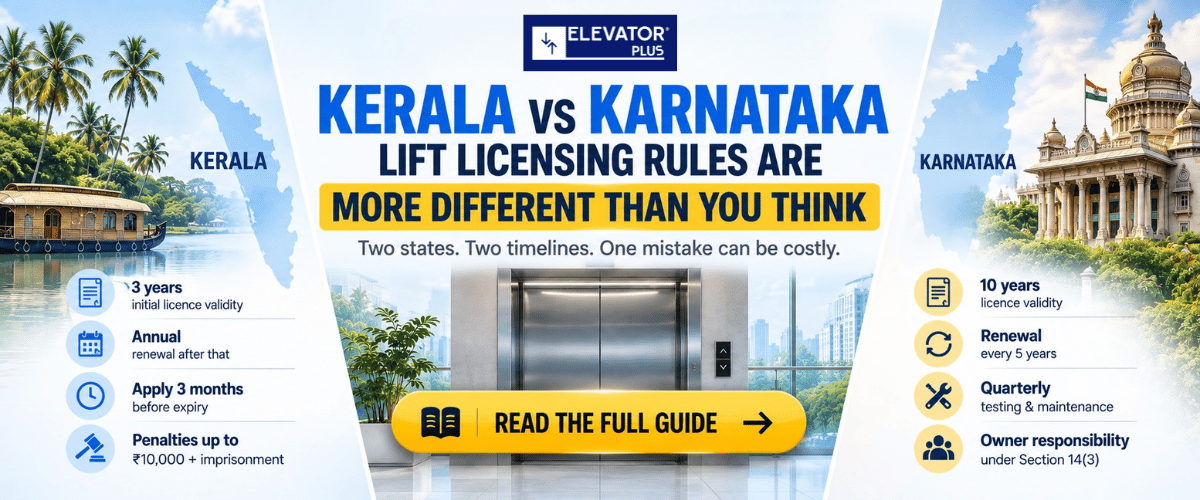
In short: Kerala and Karnataka run lift licensing on opposite clocks. Under Section 4(5) of the Kerala Lifts and Escalators Act 2013, as amended by Act 14 of 2018, a licence is valid for three years from grant and is renewed annually after that, following an inspection, with the renewal application due at least three months before expiry under Section 6(1). Karnataka grants ten years under Section 5 of its 2012 Act, renews every five, and instead requires testing and maintenance by a registered person once in every three months under Section 14(3). One checklist cannot cover both.
Key takeaways
- A Kerala licence is three years once, then annual forever. Section 4(5) of the Kerala Lifts and Escalators Act 2013, as amended by Act 14 of 2018, provides that every licence granted is valid for three years from the date of grant and is renewed thereafter annually, after an inspection and on payment of the prescribed fees.
- The Kerala deadline is three months before expiry, not the expiry itself. Section 6(1) of the Kerala Lifts and Escalators Act 2013 requires the renewal application to be submitted no later than three months ahead of expiry. An operator who diarises the expiry date has already missed it.
- A Karnataka licence runs ten years and renews every five. Section 5 of the Karnataka Lifts, Escalators and Passenger Conveyors Act 2012 provides that, unless an addition or alteration is made, every licence is valid for ten years from the date on which it is granted, with renewal every five years thereafter.
- Karnataka's real obligation is quarterly, not decennial. Section 14(3) of the Karnataka Lifts, Escalators and Passenger Conveyors Act 2012 requires the owner of a building in which a lift, escalator or passenger conveyor is installed to get it tested and maintained by a registered person once in every three months.
- Kerala's penalty is a flat fine, not an escalating one. Section 15 of the Kerala Lifts and Escalators Act 2013 sets a fine of five thousand rupees which may extend to ten thousand rupees. The Act does not provide for a daily continuing fine or for imprisonment.
- The two errors are mirror images and both are silent. A Kerala checklist run in Bengaluru keeps the licence immaculate and skips quarterly testing under Section 14(3). A Karnataka checklist run in Kochi treats the licence as a long horizon problem and misses Section 6(1).
What this guide covers: what Kerala requires for a licence · when a Kerala renewal must be filed · Kerala penalties · what Karnataka requires instead · Karnataka penalties · the two states side by side · why this catches experienced operators · what to do if you operate in both · a note on Maharashtra · FAQs.
The two states are built on opposite assumptions
Most elevator companies expanding across South India build their compliance process around whichever state they started in. It works until it does not.
The two most common Indian lift statutes an operator meets early are the Kerala Lifts and Escalators Act 2013 and the Karnataka Lifts, Escalators and Passenger Conveyors Act 2012. They are near neighbours geographically and nothing alike in structure. Kerala puts the weight on the licence and renews it often. Karnataka puts almost no weight on the licence and instead attaches a recurring physical obligation to the building owner.
This is what each one actually says.
What does Kerala require for a lift licence?
Kerala runs on two separate permissions.
The first is permission to erect. Section 3(1) of the Kerala Lifts and Escalators Act 2013 states that no owner of a place shall erect a lift or escalator except under, and in accordance with, a permission granted under the Act. That permission is valid for one year under Section 3(3), and may be extended by one further year on an application stating sufficient reasons.
Once erection is complete, Section 3(4) requires the owner to send a report of completion to the Inspector within one month. This completion report is the step that sits between the erection permission and the first licence application.
The second is the licence to operate. Section 4(1) states that no owner shall work, or allow the working of, any lift or escalator except under and in accordance with a licence.
The licence application itself carries a requirement most operators meet once and then forget. Under Rule 4(1) of the 2012 Rules, the Form C application goes in with the manufacturer's completion report in Form D, the electrical contractor's report in Form E, the fee challan, and a copy of the owner's insurance policy covering the persons who use the lift. The Inspector then inspects within fifteen days and grants the licence in Form F.
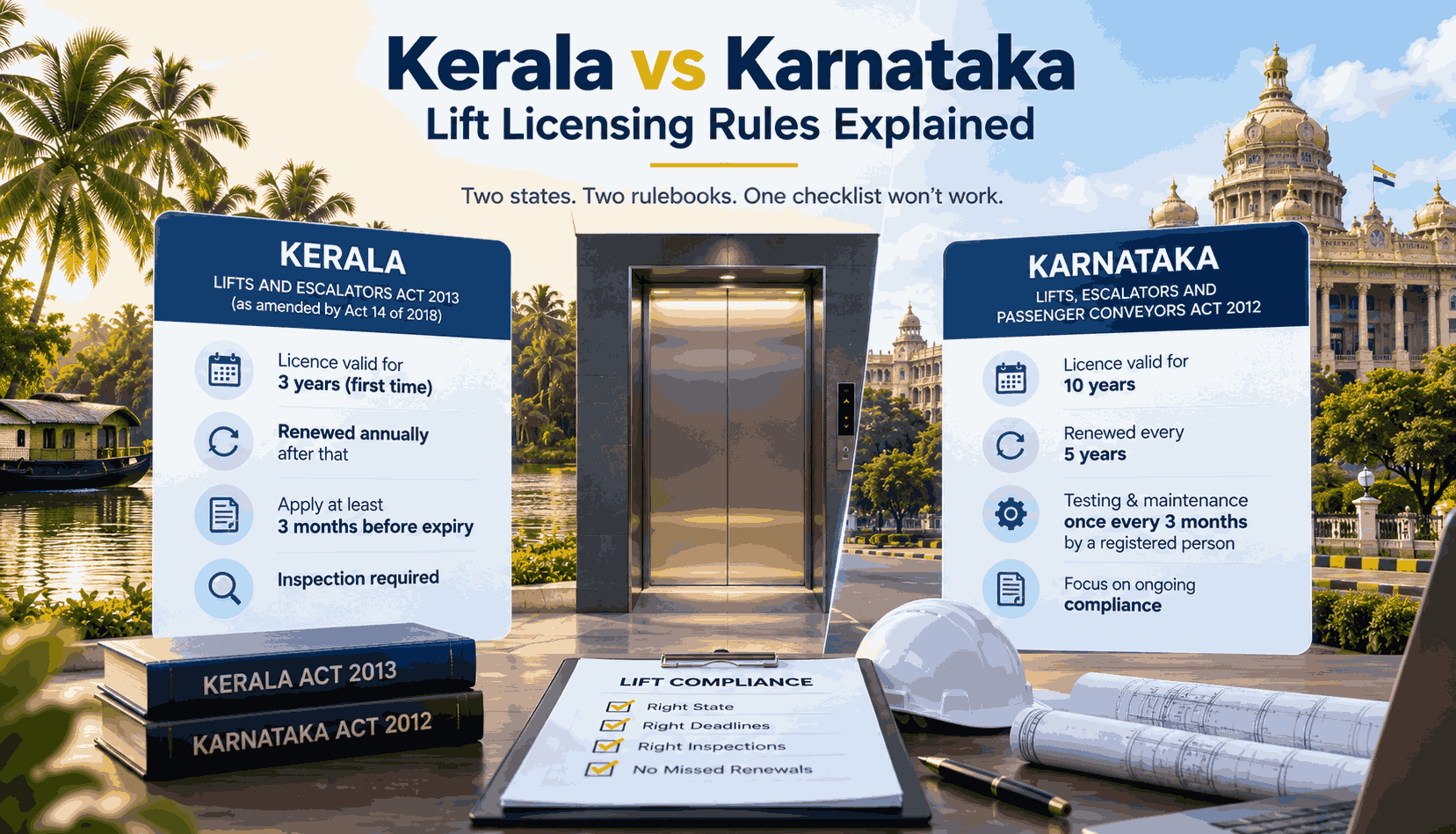
The validity of that licence changed in 2018. Section 4(5), as amended by Act 14 of 2018, provides that every licence granted shall be valid for a period of three years from the date on which it is granted, and shall be renewed thereafter annually after an inspection and on payment of the prescribed fees.
Read that carefully, because the structure catches people out. It is not a three year licence that renews every three years. It is three years, and then every single year after that, with an inspection attached to each renewal.
When does a Kerala renewal application have to be filed?
At least three months before the licence expires.
Section 6(1) requires the renewal application to be submitted no later than three months ahead of expiry. This is the single most missed date in Kerala lift compliance, because it sits three months earlier than instinct suggests. An operator who diarises the expiry date has already missed the deadline by the time the reminder fires.
Section 4(5A), also inserted by Act 14 of 2018, allows the Electrical Inspector to conduct an inspection every year, and to proceed under Section 7 where a violation is found.
The Electrical Inspector is the authority named in the Kerala Act, exercising jurisdiction over the location of the installation.
What are the penalties in Kerala?
Section 15 of the Kerala Lifts and Escalators Act 2013 sets a fine of five thousand rupees which may extend to ten thousand rupees. The Act does not provide for a daily continuing fine or for imprisonment under this section.
The fine is rarely the expensive part. The expensive part is a client asking for a compliance record three weeks before an AMC renewal is signed, and the record not existing.
One more difference matters more than the dates. Kerala prescribes no log book, no maintenance register and no maintenance report, and it sets no testing interval for the maintainer at all. The owner must display the licence, produce it when called for, and report defects forthwith. Nothing in the Act or the 2012 Rules requires a record of what was done to the lift. In Kerala the only record that protects you is the one your own contract requires, which means the contract is doing the work the statute does not.
What does Karnataka require instead?
Karnataka is generous where Kerala is strict, and strict where Kerala is quiet.
Section 5 of the Karnataka Lifts, Escalators and Passenger Conveyors Act 2012 provides that unless an addition or alteration is made to the lift, escalator or passenger conveyor, every licence shall be valid for a period of ten years from the date on which it is granted. Renewal then runs every five years.
Ten years. Against Kerala's three years followed by annual renewals.
Then Section 14(3) introduces the requirement that most operators coming from another state miss entirely. The owner of a building in which a lift, escalator or passenger conveyor is installed shall get it tested and maintained by a registered person once in every three months.
Quarterly. Four documented tests a year, by a registered person, on every unit. Section 15(1) separately requires every owner to enter into a contract with the registered person for the satisfactory maintenance of the unit, including cleaning, oiling, adjusting and repairing.
Section 14(1) provides for inspection at prescribed intervals by an authorised officer. Rule 17(1) of the 2015 Rules sets that interval at once a year. This annual official inspection is a separate obligation from the owner's own quarterly test under Section 14(3) one is carried out by the government, the other is arranged by the owner through a registered contractor.
Karnataka has its own three-month rule, and it is where the quarterly obligation bites. Rule 5(1) of the 2015 Rules requires the renewal application three months before expiry, in Form C1, with the original licence and the registered person's test certificate in Form C2 for a lift, or Form C3 for an escalator or passenger conveyor. The certificate comes from the registered person, and the registered person can only certify what was tested. A decade of missed quarterly tests surfaces on the day the renewal is filed, not before.
What are the penalties in Karnataka?
Section 19 of the Karnataka Lifts, Escalators and Passenger Conveyors Act 2012 sets a fine of up to ten thousand rupees, simple imprisonment of up to six months, or both, with a further fine of up to one hundred rupees for every day a contravention continues after the first. Karnataka is the one that runs a daily fine and provides for imprisonment. Kerala's Section 15 is a flat fine only, with no daily fine and no imprisonment provision.
Kerala and Karnataka side by side
| Point of comparison | Kerala | Karnataka |
|---|---|---|
| Governing statute | Kerala Lifts and Escalators Act 2013, as amended by Act 14 of 2018 | Karnataka Lifts, Escalators and Passenger Conveyors Act 2012 |
| Licence validity from grant | Three years from the date of grant, Section 4(5) | Ten years from the date of grant, Section 5 |
| Renewal cycle after that | Annually, after an inspection and on payment of the prescribed fees, Section 4(5) | Every five years, Section 5 |
| Recurring physical obligation | Inspection attached to each annual renewal, Section 4(5); the Electrical Inspector may inspect every year, Section 4(5A) | Testing and maintenance by a registered person once in every three months, Section 14(3), plus a maintenance contract with a registered person, Section 15(1) |
| The deadline that gets missed | The renewal application, due at least three months before expiry, Section 6(1) | The quarterly test, because nothing in the ten-year licence prompts it, Section 14(3) — and it surfaces at renewal, which must be filed three months early with the registered person's test certificate, Rule 5(1) |
Read the last row on its own. In Kerala the thing people miss is a piece of paper filed too late. In Karnataka the thing people miss is a visit that never happened, and a ten year licence is exactly long enough for nobody to notice.
👉 Running units in both states and not sure which dates are already overdue?
See how recurring compliance and AMC reminders are scheduled per unit →
Why does this catch experienced operators?
Because the two states are near neighbours, and because the mistake is silent in both directions.
An office running a Kerala checklist in Bengaluru will keep the licence paperwork immaculate and quietly skip quarterly testing, because nothing in the Kerala process ever asks for it.
An office running a Karnataka checklist in Kochi will assume the licence is a long horizon problem, and will discover that the Kerala renewal window closed three months before they thought it opened.
Neither mistake produces an alarm. Both produce a gap in the record that only appears when somebody asks for the record, which is usually at renewal, or after an incident, or during a handover to a second generation who wants to know what they are inheriting.
What should an operator in both states actually do?
Four things, in this order.
Separate your compliance calendar by state rather than by client. The obligations attach to the jurisdiction, not to the account.
For every Kerala unit, record the licence grant date, not just the expiry. The grant date tells you whether you are still inside the initial three year window or into the annual cycle, and those behave differently.
For every Kerala unit, set the working deadline at four months before expiry, not three. The statute says three. A month of margin is what turns a statutory deadline into an operational one you actually hit.
For every Karnataka unit, count the documented tests on record for the last twelve months. If the answer is fewer than four, that is a live gap, and it is the gap most likely to be asked about.
A note on Maharashtra
Maharashtra does not run a third licence clock at all. The 2017 Act has never come into force, and the amendment Act passed in March 2026 has not been brought into force either, so the state still operates under the 1939 Act and the 1958 Rules. Those set no licence validity term. What they do set is inspection at least once in six months under Section 11, although the inspection fee is annual and the inspectorate publishes its statistics annually, so operators there are used to an annual rhythm. The point for now is only this. The licence clock is set state by state, and there is no national Indian lift clock to learn.
How this connects to the rest of your operation
Compliance dates are not really a compliance problem. They are a records problem wearing a compliance hat. Under Rule 12(4) of the Karnataka Rules, minimum maintenance work must be logged in a register in Form H1, and the owner must obtain an annual testing and maintenance report in Form C2 or Form C3.
The reason a quarterly test gets missed is not that anyone decided to skip it. It is that the test was done, the technician noted it, and the note lived in a service register in a branch office where nobody can find it eleven months later. The reason a Kerala renewal is filed late is not negligence. It is that the grant date sits in a file, the expiry sits in someone's calendar, and the three month rule sits in nobody's.
A per lift asset register that holds every visit, every test and every certificate against the unit itself turns all of the above into a filter rather than a memory exercise. That is the same record that supports an AMC renewal conversation, which is why the two problems are worth solving together rather than separately.
Frequently asked questions
1. How long is a lift licence valid in Kerala?
Three years from the date on which it is granted. Section 4(5) of the Kerala Lifts and Escalators Act 2013, as amended by Act 14 of 2018, provides that every licence granted is valid for three years from grant and is renewed thereafter annually, after an inspection and on payment of the prescribed fees.
2. How long is a lift licence valid in Karnataka?
Ten years from the date on which it is granted, under Section 5 of the Karnataka Lifts, Escalators and Passenger Conveyors Act 2012, unless an addition or alteration is made to the lift, escalator or passenger conveyor. Renewal then runs every five years.
3. How often must a lift be tested in Karnataka?
Once in every three months. Section 14(3) of the Karnataka Lifts, Escalators and Passenger Conveyors Act 2012 requires the owner of a building in which a lift, escalator or passenger conveyor is installed to get it tested and maintained by a registered person once in every three months.
4. When must a Kerala licence renewal be applied for?
At least three months before the licence expires. Section 6(1) of the Kerala Lifts and Escalators Act 2013 requires the renewal application to be submitted no later than three months ahead of expiry, which is why diarising the expiry date alone is not enough.
5. Does a Kerala lift licence renew every three years?
No. It is valid for three years from grant and is then renewed annually, with an inspection attached to each renewal, under Section 4(5) of the Kerala Lifts and Escalators Act 2013 as amended by Act 14 of 2018.
6. What is the penalty for operating a lift without a valid licence in Kerala?
Section 15 of the Kerala Lifts and Escalators Act 2013 sets a fine of five thousand rupees which may extend to ten thousand rupees. The Act does not provide for a daily continuing fine or for imprisonment under this section.
7. Can one compliance checklist cover both states?
No. The obligations do not overlap. Kerala's recurring event is an annual licence renewal filed three months early under Sections 4(5) and 6(1) of its 2013 Act. Karnataka's recurring event is a quarterly test by a registered person under Section 14(3) of its 2012 Act, sitting under a licence that does not expire for ten years. A single list will always drop one of them.
📲 Join our WhatsApp channel for compliance tips, updates: ElevatorPlus - Business Automation Tool
Two states, two statutes, two clocks that do not line up at any point.
Kerala asks you to file early and often. The licence is three years, then annual, and the application is due three months before expiry. The failure mode is administrative and it is fast.
Karnataka asks you to show up on site four times a year and prove it. The licence is ten years, renewed every five, and the obligation that actually bites is Section 14(3). The failure mode is quiet and it accumulates for a decade before anyone looks.
The operator who gets both right is not the one with the better memory. It is the one holding grant dates, expiry dates, renewal filing dates and quarterly test records against each individual unit, per state, in one place that somebody else can open.
This article summarises statutory provisions for operational planning. It is general information and not legal advice. Confirm your own position and the current requirements with the relevant authority before acting on a compliance decision.
👉 See per unit compliance records across multiple Indian states. Book a demo →
Related reading
- What Is Elevator Service Software
- The Clauses That Decide Whether a Lift AMC Makes Money
- Malaysia's DOSH Certificate of Fitness: The 15-Month Cycle Explained
- Philippines Lift Compliance 2026: The Certificate Nobody Renews on Time
About the author. Mr. Sumeet Katariya is the founder of ElevatorPlus, the Elevator Business Operating System used by 200+ elevator companies across 20+ countries.
Sources: Kerala Lifts and Escalators Act, 2013 (Act 18 of 2013), Sections 3, 4, 6 and 15, as amended by the Kerala Lifts and Escalators (Amendment) Act, Act 14 of 2018 · Karnataka Lifts, Escalators and Passenger Conveyors Act, 2012, Sections 5, 14 and 15. Primary statutory text only. Citations are given as act, section and year in plain text rather than as links, because we do not publish a government URL we have not confirmed.
👉 Follow ElevatorPlus on,
Instagram LinkedIn Facebook YouTube Qoura Substack Twitter