23
May, 2026
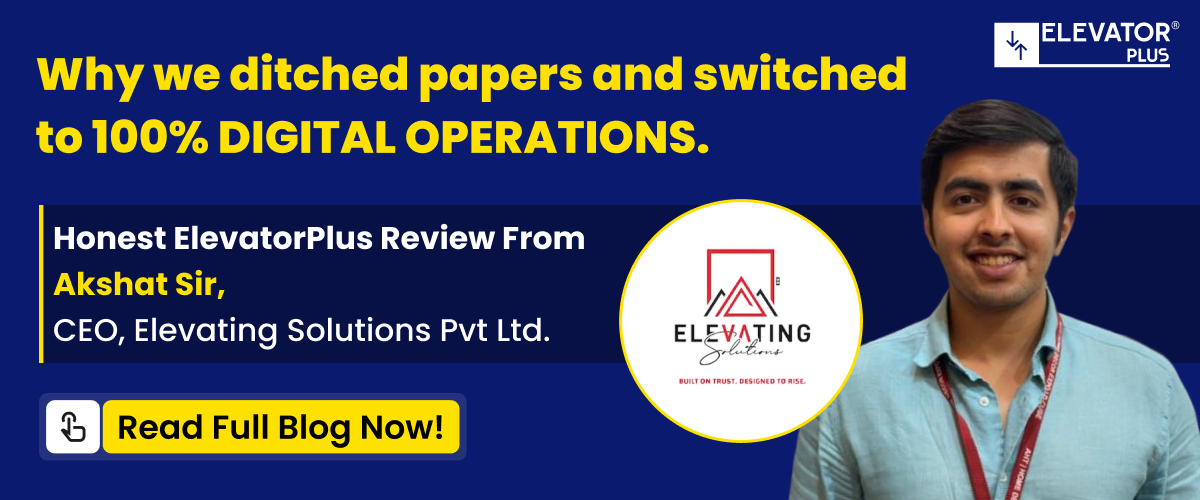
ElevatorPlus Nepal: How Elevating Solutions Went Digital
Published · Last updated
There is a moment most elevator company owners recognize immediately.
You are in the middle of a site visit, and your phone rings. It is the office – a customer has called about a breakdown, the technician on duty is not sure which building it is, and no one can find the service record because it is buried in a folder somewhere. You hang up, make three more calls, piece together the answer from memory, and resolve it. An hour later, the same thing happens at a different site.
This is not a bad day. For many lift companies across Nepal and across South Asia, this is Tuesday.
Mr. Akshat Maheshwari, CEO of Elevating Solutions Pvt Ltd. in Kathmandu, Nepal, knew this feeling well. His company was growing – more towers, more AMC contracts, more technicians in the field. But the systems holding it all together were not growing with it. They were built on paper, personal memory, and trust in a handful of senior people who held everything in their heads.
Then he chose ElevatorPlus.
This is the story of what that decision looked like, why it was not always easy, and what it has meant for Elevating Solutions on the other side of the transition.
Service tickets are written on paper job cards and handed to technicians at the start of the day. AMC renewals are tracked in Excel, or remembered by one staff member who happens to know the renewal dates. Breakdown calls come directly to the owner's mobile. Technician dispatch is handled over WhatsApp. Customer complaints are followed up – or not – based on whoever has time that afternoon.
This is not because elevator companies lack capability. It is because the industry is operationally demanding and highly relationship-driven, and the software options historically available were either too generic (built for IT companies, not lift companies) or too complex for a team that is already stretched thin running daily service operations.
The result: revenue leaks quietly. AMC renewals lapse. Customers call the owner directly. And the business can only growas fast as the owner can personally oversee.

Mr. Akshat Maheshwari built Elevating Solutions from this same starting point. The company's operations were tracked manually. Service visits were handled through paper. Everything ran on the team's effort and institutional knowledge – which worked, until the complexity of a growing business started to outpace what paper and memory could handle.
"Currently in our working style, everything was tracked manually through papers, and services were done manually. A lot of paperwork was there. So we wanted to transform everything digitally so that tracking becomes very easy and the efficiency of the team and the back office increases. That way management has a better view of the overall operations." – Mr. Akshat Maheshwari, CEO, Elevating Solutions Pvt Ltd, Kathmandu, Nepal.
Three words stand out in that answer: tracking, efficiency, and visibility.
These are not abstract goals. For an elevator AMC service provider managing multiple buildings across Kathmandu, they translate into very specific daily problems:
That is the insight that brought Akshat to ElevatorPlus.
The language is different. The workflows are different. The daily rhythm of breakdown calls, routine maintenance visits, AMC renewals, spare parts requests, and technician dispatch does not map neatly onto a system designed for a retail business or a financial services firm.
Akshat and his team at Elevating Solutions needed elevator management software that was built for the way their business operated – not a generic platform they would have to bend into shape.
ElevatorPlus was built specifically for this industry. It runs AMC contracts, service tickets, technician dispatch, complaint resolution, and quotation workflows from a single platform. It was not adapted from a generic CRM. It was designed from the ground up for elevator service businesses – the terminology, the workflows, the reporting – all of it built around how lift companies actually operate day to day.
That specificity matters. When a software platform understands the difference between a routine maintenance visit and a breakdown call, when it tracks AMC expiry dates the way an elevator company needs them tracked, when it handles spare parts inventory with the logic a service team actually uses – adoption becomes possible in a way it simply is not with generic tools.
The transition is not instant. It is not always smooth. And it requires the business to make a choice that not every owner is prepared for.
Akshat puts it clearly:
"The only suggestion I would like to give is that it is very difficult to transition from existing setups where we don't have software and processes in place. Sometimes we might have to change our process for the ERP or the solution to work. But it is for our good. We should not try to bend the system to get our work done but rather switch the way so that things get automated and everything becomes smooth. At the end of the day it is a win for both management and the team." – Mr. Akshat Maheshwari, CEO, Elevating Solutions
This is one of the most honest and useful observations any business leader can offer about software implementation and it is worth unpacking.
Most companies approach a new ERP or CRM with the assumption that the software should fit their existing process exactly. If the software does not match the current workflow, the instinct is to ask for a customisation, find a workaround, or abandon the tool.
But Mr. Akshat's experience points to a different truth: the process that got you here is often the process causing the problems you are trying to solve. If manual paper-tracking created the inefficiency, replicating that manual logic inside a digital system does not fix it. It just digitises the problem.
The companies that get the most from elevator business automation are the ones willing to let the software define the new standard and train the team to operate within it, rather than around it.
This does not mean the software gets to ignore the business. It means the implementation has to be collaborative. Which brings us to one of the aspects of ElevatorPlus that Akshat speaks to directly.
Mr. Akshat is direct about the early phase:
"Initially we had hiccups because of the support being online and in the transition phase."
That is a real thing. Migrating from paper-based tracking to digital service management means the team is learning new habits while continuing to handle daily operations. Service calls do not pause for software training. Breakdown calls do not wait for a system migration to complete.
What made the difference, in Mr. Akshat's account, was the quality of support:
"Overall it was very smooth, very supportive from your team, yourself, and all our requests were accommodated ,all our formats and the things we do in our own style. Everything was accommodated very well."
This is the ElevatorPlus implementation model in practice. The platform is configured for how the business actually operates. The team is trained within the context of their real workflows. Requests for customisation, specific formats, reporting structures, ways of logging information – are worked through with the team, not handed off to a generic support queue.
For elevator companies in Nepal and across South Asia, where software adoption depends as much on trust and hands-on support as it does on features, this matters enormously. A system that is technically capable but poorly implemented will fail. A system that is well-implemented – even if the transition takes adjustment – has a far better chance of sticking.
For the back office: Paper-based logging is replaced by digital service records. Every completed visit, every open ticket, and every pending AMC renewal is visible in the system. Staff no longer spend time searching through physical files to answer a customer query – the information is a search away.
For technicians in the field: Service assignments are tracked through the platform. Dispatch is managed through the system rather than via WhatsApp messages that disappear into a chat thread. Job completion is logged digitally, creating a service history that is accessible to management and the back office without anyone having to transcribe a paper job card.
For the management team: This is where the change is most significant. With manual operations, management visibility depends on phone calls, WhatsApp updates, and the reliability of individual team members to report accurately. With ElevatorPlus, the picture is available from one screen – open tickets, completed visits, AMC contracts approaching renewal, pending complaints.
The owner no longer needs to be physically present or constantly reachable to know what is happening. That is not a small thing. It is the difference between a business that depends on one person and a business that can run on a system.
For Mr. Akshat and Elevating Solutions, this visibility was one of the core goals from the start: "Management has a better view of the overall operations." ElevatorPlus delivered exactly that.
Here is what that means in practice for an elevator service business:
AMC Management: AMC contracts are tracked with expiry alerts and renewal workflows built into the system. Renewals do not slip because no one remembered to check. The system does the remembering.
Service Ticket Management: Breakdown calls and routine maintenance visits are logged, assigned, and tracked from the platform. Every ticket has a history. Every completed visit leaves a digital record.
Technician Dispatch: Technicians receive assignments through the system. Field activity is tracked without requiring WhatsApp updates or manual check-ins.
Complaint Resolution: Customer complaints are logged, escalated, and closed through a structured workflow not handled through a mix of phone calls and personal memory.
Management Visibility: The business picture is available from one screen. Open tickets, AMC status, technician availability, service history – all in one place, available in real time.
Mobile and Multi-Platform: ElevatorPlus runs on Android, iOS, desktop, and web – so the platform works whether the owner is in the office, on a site visit, or travelling.
Hands-On Implementation: Unlike generic software that ships with a login and a knowledge base, ElevatorPlus comes with an implementation partnership. Data migration, system configuration, team training, and ongoing support – the team stays involved through adoption, not just setup.
The transition is not always instant. But as Akshat puts it, "At the end of the day it is a win for both management and the team."
Book a free demo with the ElevatorPlus team to see how the platform runs AMC management, service ticket tracking, and technician dispatch for elevator companies like yours.
Request a Free Demo Now!
You are in the middle of a site visit, and your phone rings. It is the office – a customer has called about a breakdown, the technician on duty is not sure which building it is, and no one can find the service record because it is buried in a folder somewhere. You hang up, make three more calls, piece together the answer from memory, and resolve it. An hour later, the same thing happens at a different site.
This is not a bad day. For many lift companies across Nepal and across South Asia, this is Tuesday.
Mr. Akshat Maheshwari, CEO of Elevating Solutions Pvt Ltd. in Kathmandu, Nepal, knew this feeling well. His company was growing – more towers, more AMC contracts, more technicians in the field. But the systems holding it all together were not growing with it. They were built on paper, personal memory, and trust in a handful of senior people who held everything in their heads.
Then he chose ElevatorPlus.
This is the story of what that decision looked like, why it was not always easy, and what it has meant for Elevating Solutions on the other side of the transition.
The State of Most Elevator Businesses Before Software
Before we get to Mr. Akshat's story, it is worth being direct about an industry-wide reality: most elevator and lift maintenance businesses in South Asia – and frankly across the world – are still running their operations the same way they did fifteen years ago.Service tickets are written on paper job cards and handed to technicians at the start of the day. AMC renewals are tracked in Excel, or remembered by one staff member who happens to know the renewal dates. Breakdown calls come directly to the owner's mobile. Technician dispatch is handled over WhatsApp. Customer complaints are followed up – or not – based on whoever has time that afternoon.
This is not because elevator companies lack capability. It is because the industry is operationally demanding and highly relationship-driven, and the software options historically available were either too generic (built for IT companies, not lift companies) or too complex for a team that is already stretched thin running daily service operations.
The result: revenue leaks quietly. AMC renewals lapse. Customers call the owner directly. And the business can only growas fast as the owner can personally oversee.
Mr. Akshat Maheshwari built Elevating Solutions from this same starting point. The company's operations were tracked manually. Service visits were handled through paper. Everything ran on the team's effort and institutional knowledge – which worked, until the complexity of a growing business started to outpace what paper and memory could handle.
"Everything Was Tracked Manually Through Papers"
When asked what drove him to look for an elevator service management software solution, Akshat sir is candid."Currently in our working style, everything was tracked manually through papers, and services were done manually. A lot of paperwork was there. So we wanted to transform everything digitally so that tracking becomes very easy and the efficiency of the team and the back office increases. That way management has a better view of the overall operations." – Mr. Akshat Maheshwari, CEO, Elevating Solutions Pvt Ltd, Kathmandu, Nepal.
Three words stand out in that answer: tracking, efficiency, and visibility.
These are not abstract goals. For an elevator AMC service provider managing multiple buildings across Kathmandu, they translate into very specific daily problems:
- Tracking – Which technician went where? Was the service visit completed? Was the job card submitted? Is the AMC for a particular tower up for renewal this quarter?
- Efficiency – How long is the back office spending on manual data entry, handwritten reports, and searching through paper records to answer a single customer question?
- Visibility – Can the management team see the full picture of operations at any given moment, or is every status update a phone call away?
That is the insight that brought Akshat to ElevatorPlus.
Choosing Elevator ERP Software: What the Decision Actually Looks Like
Choosing a software platform for an elevator business is not a quick decision. Operators in this space have often tried generic CRMs or ERPs before – and found them abandoned by the team within weeks because the system did not understand how a lift company actually works.The language is different. The workflows are different. The daily rhythm of breakdown calls, routine maintenance visits, AMC renewals, spare parts requests, and technician dispatch does not map neatly onto a system designed for a retail business or a financial services firm.
Akshat and his team at Elevating Solutions needed elevator management software that was built for the way their business operated – not a generic platform they would have to bend into shape.
ElevatorPlus was built specifically for this industry. It runs AMC contracts, service tickets, technician dispatch, complaint resolution, and quotation workflows from a single platform. It was not adapted from a generic CRM. It was designed from the ground up for elevator service businesses – the terminology, the workflows, the reporting – all of it built around how lift companies actually operate day to day.
That specificity matters. When a software platform understands the difference between a routine maintenance visit and a breakdown call, when it tracks AMC expiry dates the way an elevator company needs them tracked, when it handles spare parts inventory with the logic a service team actually uses – adoption becomes possible in a way it simply is not with generic tools.
The Transition: What "Going Digital" Actually Requires
Here is the part of digital transformation stories that most marketing content skips.The transition is not instant. It is not always smooth. And it requires the business to make a choice that not every owner is prepared for.
Akshat puts it clearly:
"The only suggestion I would like to give is that it is very difficult to transition from existing setups where we don't have software and processes in place. Sometimes we might have to change our process for the ERP or the solution to work. But it is for our good. We should not try to bend the system to get our work done but rather switch the way so that things get automated and everything becomes smooth. At the end of the day it is a win for both management and the team." – Mr. Akshat Maheshwari, CEO, Elevating Solutions
This is one of the most honest and useful observations any business leader can offer about software implementation and it is worth unpacking.
Most companies approach a new ERP or CRM with the assumption that the software should fit their existing process exactly. If the software does not match the current workflow, the instinct is to ask for a customisation, find a workaround, or abandon the tool.
But Mr. Akshat's experience points to a different truth: the process that got you here is often the process causing the problems you are trying to solve. If manual paper-tracking created the inefficiency, replicating that manual logic inside a digital system does not fix it. It just digitises the problem.
The companies that get the most from elevator business automation are the ones willing to let the software define the new standard and train the team to operate within it, rather than around it.
This does not mean the software gets to ignore the business. It means the implementation has to be collaborative. Which brings us to one of the aspects of ElevatorPlus that Akshat speaks to directly.
What the Implementation Experience Looked Like
Going from zero software to a fully operational elevator management system is a significant operational change. Especially for a company that has built its processes on paper for years.Mr. Akshat is direct about the early phase:
"Initially we had hiccups because of the support being online and in the transition phase."
That is a real thing. Migrating from paper-based tracking to digital service management means the team is learning new habits while continuing to handle daily operations. Service calls do not pause for software training. Breakdown calls do not wait for a system migration to complete.
What made the difference, in Mr. Akshat's account, was the quality of support:
"Overall it was very smooth, very supportive from your team, yourself, and all our requests were accommodated ,all our formats and the things we do in our own style. Everything was accommodated very well."
This is the ElevatorPlus implementation model in practice. The platform is configured for how the business actually operates. The team is trained within the context of their real workflows. Requests for customisation, specific formats, reporting structures, ways of logging information – are worked through with the team, not handed off to a generic support queue.
For elevator companies in Nepal and across South Asia, where software adoption depends as much on trust and hands-on support as it does on features, this matters enormously. A system that is technically capable but poorly implemented will fail. A system that is well-implemented – even if the transition takes adjustment – has a far better chance of sticking.
What Changes After Implementation: Visibility, Efficiency, and Control
Once a lift maintenance business moves off paper and onto a connected elevator service tracking platform, the operational changes are concrete and immediate.For the back office: Paper-based logging is replaced by digital service records. Every completed visit, every open ticket, and every pending AMC renewal is visible in the system. Staff no longer spend time searching through physical files to answer a customer query – the information is a search away.
For technicians in the field: Service assignments are tracked through the platform. Dispatch is managed through the system rather than via WhatsApp messages that disappear into a chat thread. Job completion is logged digitally, creating a service history that is accessible to management and the back office without anyone having to transcribe a paper job card.
For the management team: This is where the change is most significant. With manual operations, management visibility depends on phone calls, WhatsApp updates, and the reliability of individual team members to report accurately. With ElevatorPlus, the picture is available from one screen – open tickets, completed visits, AMC contracts approaching renewal, pending complaints.
The owner no longer needs to be physically present or constantly reachable to know what is happening. That is not a small thing. It is the difference between a business that depends on one person and a business that can run on a system.
For Mr. Akshat and Elevating Solutions, this visibility was one of the core goals from the start: "Management has a better view of the overall operations." ElevatorPlus delivered exactly that.
Why ElevatorPlus for Elevator Companies?
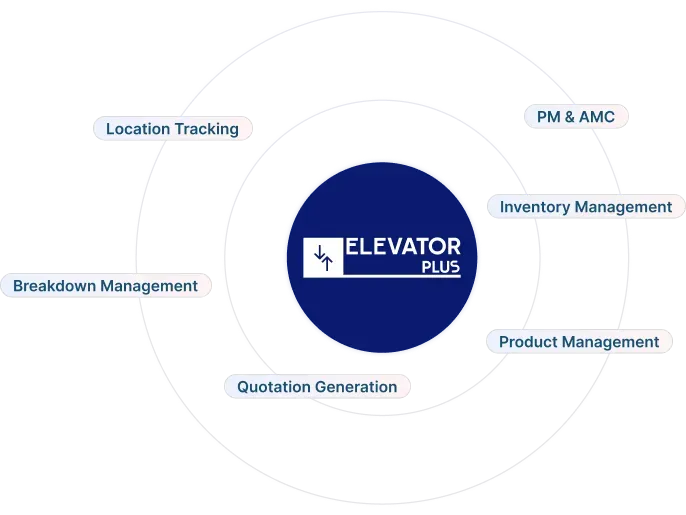
ElevatorPlus is not a repurposed generic CRM. It is not a field service management tool borrowed from another industry. It is an operating platform built specifically for elevator and lift companies covering every major function from sales and quoting through to service ticket management, technician dispatch, complaint resolution, AMC renewal tracking, and spare parts inventory.Here is what that means in practice for an elevator service business:
AMC Management: AMC contracts are tracked with expiry alerts and renewal workflows built into the system. Renewals do not slip because no one remembered to check. The system does the remembering.
Service Ticket Management: Breakdown calls and routine maintenance visits are logged, assigned, and tracked from the platform. Every ticket has a history. Every completed visit leaves a digital record.
Technician Dispatch: Technicians receive assignments through the system. Field activity is tracked without requiring WhatsApp updates or manual check-ins.
Complaint Resolution: Customer complaints are logged, escalated, and closed through a structured workflow not handled through a mix of phone calls and personal memory.
Management Visibility: The business picture is available from one screen. Open tickets, AMC status, technician availability, service history – all in one place, available in real time.
Mobile and Multi-Platform: ElevatorPlus runs on Android, iOS, desktop, and web – so the platform works whether the owner is in the office, on a site visit, or travelling.
Hands-On Implementation: Unlike generic software that ships with a login and a knowledge base, ElevatorPlus comes with an implementation partnership. Data migration, system configuration, team training, and ongoing support – the team stays involved through adoption, not just setup.
Key Takeaways
- Paper-based operations are the single biggest constraint on elevator company growth. AMC slippage, delayed breakdown response, and poor management visibility all trace back to manual tracking.
- Digital transformation in elevator businesses requires process change, not just software. As Akshat Maheshwari notes, trying to bend the system to fit old processes misses the point. The automation only works when the team operates within the system.
- Industry-specific software outperforms generic tools. Elevator management software built for lift companies – with AMC workflows, service ticket logic, and technician dispatch built in – has far higher adoption rates than generic CRMs adapted for the purpose.
- Implementation support is as important as product features. The difference between software that sticks and software that gets abandoned is often the quality of onboarding and ongoing support.
- Elevator companies in Nepal and South Asia are at an inflection point. Infrastructure growth is accelerating. The businesses that build proper operational systems now will be the ones that scale successfully through the next decade.
- ElevatorPlus is built for this transition. From AMC management to technician dispatch to complaint resolution, the platform covers the full operational picture of an elevator service business – and the team stays with customers through implementation.
Why are elevator companies in Nepal moving to software?
Nepal's infrastructure growth – particularly in Kathmandu and other urban centres , is increasing demand for elevator installation and maintenance services. As elevator companies manage more towers, more AMC contracts, and larger field teams, manual tracking systems become operationally unsustainable. Elevator management software helps companies scale operations without scaling paperwork, improve management visibility, and deliver better service to customers.About ElevatorPlus -
ElevatorPlus is the operating system for elevator service businesses. Built specifically for lift companies, ElevatorPlus replaces scattered Excel sheets, WhatsApp groups, and paper job cards with one platform that runs AMC renewals, service tickets, technician dispatch, complaint resolution, and quotation workflows. From single-tower service shops to multi-state OEMs, elevator businesses use ElevatorPlus to recover lost AMC revenue, cut breakdown response time, and put route planning, billing, and compliance on autopilot.Ready to Move Your Elevator Business Off Paper?
If Akshat Maheshwari's story sounds familiar, if your team is tracking AMC renewals in a spreadsheet, managing service calls over WhatsApp, and depending on paper records that no one can find when it matters most , ElevatorPlus was built for exactly this.The transition is not always instant. But as Akshat puts it, "At the end of the day it is a win for both management and the team."
Book a free demo with the ElevatorPlus team to see how the platform runs AMC management, service ticket tracking, and technician dispatch for elevator companies like yours.
Request a Free Demo Now!