Chicago Elevator Compliance 2026: Illinois Safety Guide
Chicago Elevator Compliance 2026: The Complete Illinois Safety Guide for Elevator Companies
Chicago's commercial property managers CBRE, JLL, Cushman & Wakefield have raised the bar. Compliance documentation, digital SLA reporting, and audit-ready service histories are no longer optional. They are the minimum requirement for contract renewal.
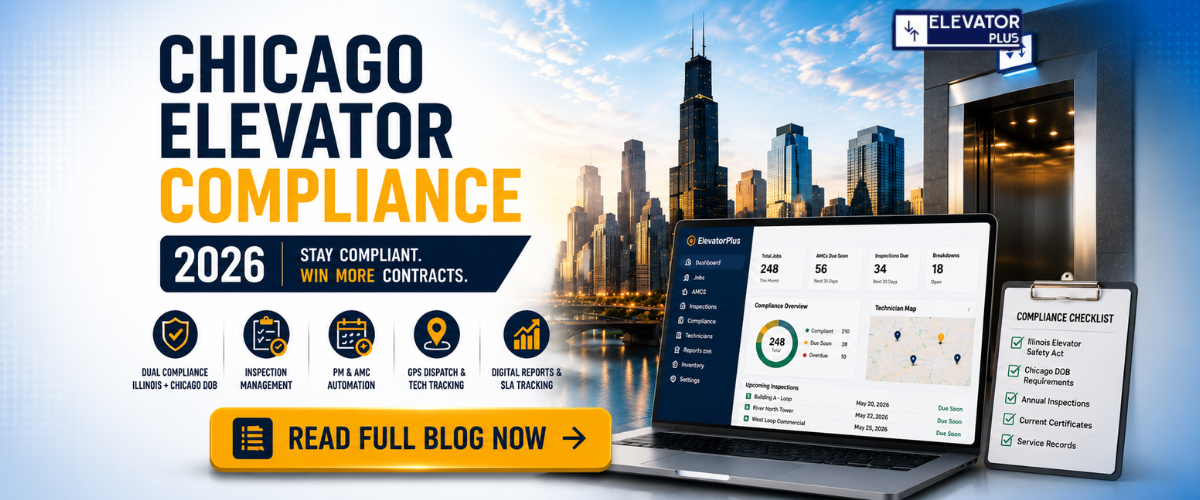
Chicago elevator compliance in 2026 operates under two regulatory layers: the Illinois Elevator Safety and Regulation Act (225 ILCS 312) at state level, and the City of Chicago Department of Buildings (DOB) inspection program locally. For companies managing mixed city and suburban portfolios, this dual requirement creates an operational burden that manual systems cannot handle at scale.
The companies treating this complexity as a burden fall behind. Those building the right infrastructure GPS dispatch, automated inspection scheduling, digital compliance documentation are winning Chicago's most valuable commercial contracts.
Book Your Free ElevatorPlus Demo See Chicago Compliance in Action
Section 1: The Current Problem Facing Chicago Elevator Companies
Chicago is the third-largest elevator market in the USA, with over 23,000 elevator units operating across downtown alone. The compliance pressure is equally significant.
Under the Illinois Elevator Safety and Regulation Act, all elevators must be inspected annually by a licensed Illinois elevator inspector. Certificates must be current and displayed in every elevator car. Service records must be accessible to inspectors on demand. Chicago's DOB adds a second layer, separate DOB-approved inspector credentials, City of Chicago inspection certificates, and owner registration with the DOB's Elevator Inspection Unit for every unit within city limits.
The business impact is direct:
-
Missed certificate renewals cost commercial contracts
-
Building owners require full compliance documentation as a standard AMC deliverable, not a special request
-
Chicago's extreme winters pit flooding, door mechanism failures, hydraulic maintenance surges overwhelm companies without automated PM scheduling
-
Independent companies that cannot produce SLA reports lose renewals to competitors who can
Start Your Free ElevatorPlus Trial Illinois Compliance, Automated
Section 2: Why This Problem Exists
The compliance crisis is not caused by lack of expertise. It is caused by operational infrastructure built for smaller portfolios. Five root causes explain it:
Manual workflows: Spreadsheet-based AMC and certificate tracking fails silently past 50–80 units. Missed renewals don't surface until a property manager flags an expired DOB certificate.
Dual-jurisdiction complexity: A unit in Evanston has different requirements from a unit on Michigan Avenue. Manual systems have no reliable way to flag these differences at the individual unit level.
Technician coordination across six counties: Routing technicians by phone across Cook, DuPage, Lake, Kane, Will, and McHenry counties creates SLA failures that cost commercial accounts.
Seasonal maintenance blind spots: Chicago's winters create a predictable surge of breakdown calls. Without automated seasonal PM scheduling, companies react instead of prevent.
No standard commercial reporting: CBRE, JLL, and Cushman & Wakefield require monthly digital service reports and ADA/ASME documentation as standard contract terms. Companies without these workflows lose renewals.
Section 3: How ElevatorPlus Solves It
ElevatorPlus delivers the specific capabilities Chicago elevator companies need, structured as Problem → Feature → Outcome:
Dual-jurisdiction compliance → Per-unit tracking for Illinois ESA and Chicago DOB. Automated certificate expiry alerts at the unit level. → Zero missed renewals across city and suburban portfolios.
Seasonal PM scheduling → Pre-configured Chicago winter prep (October–November) and post-winter checks (March–April). Automated reminders built into the PM cycle. → Proactive maintenance replaces reactive breakdown response.
Chicagoland GPS dispatch → Real-time technician tracking across all six counties. Nearest-tech assignment for breakdown calls. → Faster response times. Documented SLA performance.
Commercial portfolio reporting → Automated monthly digital service reports. One-click SLA exports. ADA and ASME A17.1 documentation per unit, on demand. → AMC renewal proposals generated automatically at 90 days before expiry.
Mobile-first field operations → Job cards completed, photos captured, and customer signatures collected on mobile before technicians leave the site. → No documentation gaps. Every job record complete and audit-ready.
Book Your Free ElevatorPlus Demo See It Live in 30 Minutes
Section 4: Real-World Example
A Chicago elevator company, with 6 technicians, 140 AMC contracts across the Loop, Lincoln Park, and Northwest suburbs was managing compliance with Google Sheets and paper job cards.
The pain: A commercial property client requested a full 12-month service and compliance report. It took two days to compile manually. During the review, two DOB certificates in the city portfolio were found to have expired unnoticed. The client renewed but trust was damaged.
After ElevatorPlus: Implemented in two days. Illinois ESA and DOB compliance schedules configured per unit. GPS dispatch activated across all six technicians.
Result: Within 60 days all 140 units on active compliance tracking, monthly reports auto-sent to clients, Friday reconciliation down from 4 hours to 20 minutes. Within 6 months 2 new commercial property management contracts won, both citing documentation quality as the deciding factor.
📲 Join our WhatsApp channel for compliance tips, updates, and exclusive offers: ElevatorPlus - Business Automation Tool
Section 5: Who Benefits and How
For Owners: Win commercial contracts requiring digital compliance documentation. Automate AMC renewals. Scale to 200+ contracts without additional admin headcount.
For Operations Teams: Single compliance dashboard for all Illinois ESA and Chicago DOB requirements. Automated inspection alerts. Real-time GPS visibility across all six Chicagoland counties.
For Technicians: Mobile job cards completed on-site. No end-of-day admin. GPS-routed dispatch means less dead time and more productive hours per day.
For Customers: Automatic monthly service reports without asking. Faster breakdown response. Full compliance visibility. ADA and ASME documentation available instantly for any audit.
Book Your Free Demo and See the Benefits Live
Section 6: The Future of Chicago's Elevator Industry
Chicago's elevator market will grow. The companies positioned to capture that growth are already building the infrastructure the market is moving toward.
Automation is the new standard. Property managers are not returning to paper compliance reviews. Automated monthly reporting and digital certificate management are now embedded in commercial contract negotiations.
Predictive maintenance is emerging. The next competitive differentiator will not be who responds to breakdowns fastest, it will be who prevents them. IoT-connected elevator monitoring tied to automated PM scheduling will define the next generation of Chicago elevator service companies.
Digital compliance will become a legal requirement. The trajectory of Illinois elevator regulation points toward mandatory digital record-keeping. Companies already on digital-first platforms will transition seamlessly. Those on paper records face a costly forced migration.
Companies that invest in operational infrastructure today are not just solving today's problems. They are positioning to win tomorrow's market.
Imagine this: It is the last week of the quarter. Instead of a manager manually combing a spreadsheet for which of 120 AMCs expire next month, the system has already flagged them, drafted the renewals, and shown which buildings had the most callbacks — the ones to renegotiate upward.
Chicago's elevator market is competitive, regulation-dense, and commercially demanding. The gap between what most independent elevator companies deliver and what the market requires is not technical it is an operational infrastructure gap.
Closing that gap takes two days to implement. What it changes is everything that comes after.
Ready to Modernize Your Chicago Elevator Operations in 2026?
ElevatorPlus is fully operational in 2 days. Illinois + Chicago DOB compliance configured. GPS dispatch active. AMC renewal automation running.
Book Your Free Strategy Call Today
👉 𝗙𝗼𝗹𝗹𝗼𝘄 𝗘𝗹𝗲𝘃𝗮𝘁𝗼𝗿𝗣𝗹𝘂𝘀 𝗼𝗻:
Instagram | LinkedIn | Facebook | YouTube
FAQ: Chicago Elevator Compliance 2026
Q1: What is Chicago elevator compliance in 2026?
Chicago elevator compliance in 2026 requires meeting both the Illinois Elevator Safety and Regulation Act (225 ILCS 312) and City of Chicago Department of Buildings (DOB) requirements. This includes annual licensed inspections, current certificates displayed in elevator cars, accessible service records, and valid Illinois elevator contractor licenses for all mechanics performing work.
Q2: Why is Illinois elevator compliance important for elevator service companies?
Illinois elevator compliance directly impacts your ability to win and retain commercial AMC contracts. Chicago property managers require audit-ready compliance documentation as a standard contract deliverable. Companies that automate compliance tracking consistently outperform competitors in commercial contract renewals across the Chicagoland market.
Q3: How does Chicago DOB compliance differ from Illinois state requirements?
Illinois state compliance covers all elevators statewide. Chicago DOB adds a second layer for units within city limits DOB-approved inspectors, City of Chicago inspection certificates, and elevator owner registration. ElevatorPlus tracks both per unit automatically, with separate schedules for city and suburban portfolios.
Q4: What does it take to win commercial property management elevator contracts in Chicago?
Chicago's commercial property managers require five standard deliverables: current Illinois and DOB compliance certificates, monthly digital service reports, documented response time SLAs, ADA and ASME A17.1 documentation on request,
and AMC renewal proposals at 90+ days before expiry. ElevatorPlus delivers all five automatically.