Singapore Lift Rules 2026: The New Fixed Installations Regim
By Nutan Mandal, ElevatorPlus · Compliance reviewed by Mr. Sumeet Katariya
In short: On 1 October 2025 Singapore moved lifts out of the Building Maintenance and Strata Management Act and into the Building Control Act, under a new category called fixed installations. If your compliance paperwork still references the old regulations, it is out of date. Here is what actually applies now, and what changes again in 2027.
Key takeaways
- Lifts, escalators and mechanised car parking are now regulated as fixed installations under the Building Control Act 1989, via the Building Control (Fixed Installations) Regulations 2025, in force 1 October 2025. The old BMSM lift regulations were repealed.
- A Permit to Operate is still required and is still valid for 12 months. Renewal work starts within three months of expiry.
- Maintenance must be carried out by a BCA-registered fixed installation contractor holding workhead RW02B. The old phrase "registered lift contractor" no longer matches the register.
- Annual examination must be witnessed by an independent Specialist Professional Engineer, who must certify they are not connected to the owner or the maintenance contractor. Getting that certification wrong carries a fine of up to S$20,000 or twelve months' imprisonment.
- Two things worth planning for now: reg 40 allows BCA to approve reduced maintenance frequency where an approved remote monitoring solution is in place, and from 2027 certification moves to a firm-based licensing regime.
What this guide covers: what changed in October 2025 · Permit to Operate · who may maintain and who must inspect · actual maintenance intervals · reportable matters · what is coming in 2027.
What changed on 1 October 2025 ?
Until last year, lifts in Singapore sat under the Building Maintenance and Strata Management Act 2004 and the BMSM (Lift, Escalator and Building Maintenance) Regulations 2016.
That framework is gone. Three instruments made under the Building Control Act 1989 replaced it:
- Building Control (Fixed Installations) Regulations 2025 (S 614/2025)
- Building Control (Reportable Matters) Regulations 2025 (S 615/2025)
- Building Control (Exempt Fixed Installations and Fixed Installation Works) Order 2025
The umbrella term is now fixed installations, covering lifts, escalators and mechanised car parking systems together.
For a contractor the practical effect is mostly terminological, but the terminology matters. Contract templates, compliance schedules and client reports that still cite the BMSM regulations are citing a repealed instrument. A managing agent who notices that will draw conclusions about how current the rest of your practice is.
One caveat before anything else: the Exempt Fixed Installations Order carves out certain installations. Check whether a given lift is in scope rather than assuming.
Permit to Operate: what keeps it valid
The Permit to Operate remains the lift's licence to run, and it remains valid for twelve months under reg 32(3)(c).
Renewal is not an administrative event at the end of the year. Under regs 29 and 30 the owner appoints a fixed installation service contractor to carry out examination, inspection and testing, and that work begins within three months before expiry. Applications run through BCA's LEAP portal.
The renewal therefore depends entirely on evidence you produced during the preceding year. If a monthly maintenance record is missing, or an examination finding has no documented rectification, the permit becomes a problem for your client and the cause traces directly back to you.
The failure we see most often is not a missed service. It is a service that was carried out properly, by a competent technician, with no retrievable record that it happened.
Who may maintain, and who must inspect ?
Singapore keeps these two roles firmly apart, and uses precise terms for both.
Maintenance is performed by a fixed installation service contractor. To hold that role a firm must be registered with BCA under Part 5B of the Building Control Act, by regulatory workhead. The relevant one for lift maintenance, inspection and testing is RW02B. Lift installation work is RW02A. Escalators and mechanised car parking have their own codes.
Annual examination must be witnessed by a Specialist Professional Engineer. The SPE is an independent professional engineer who must certify that they are not a partner, associate, director, officer or employee of either the lift owner or the lift service contractor. False certification is a criminal matter carrying up to S$20,000 and twelve months' imprisonment.
New since 2025, a Fixed Installation Inspector may assist an SPE at annual inspections. FI Inspectors are registered through a joint accreditation committee and cannot support Qualified Persons on new installations or major alterations.
| Fixed installation service contractor | Specialist Professional Engineer | |
|---|---|---|
| Role | Routine maintenance, examination, testing | Independent witness and certification |
| Registration | BCA, workhead RW02B | Professional engineer, independence certified |
| Frequency | Monthly for lifts | Annually, tied to PTO |
| Independence required | No | Yes, and criminally enforced |
The actual intervals
Under reg 39, and these are prescribed rather than negotiable:
- Lifts: monthly, or the manufacturer's recommended interval, whichever is more frequent.
- Home lifts, vertical platform lifts and stairlifts: manufacturer's recommendation or every three months, whichever is more frequent.
- Escalators: monthly.
- Mechanised car parking: manufacturer's recommendation or every three months.
- Examination, inspection and testing: annually, by the service contractor in the presence of an independent SPE.
There is an important nuance in how the 2025 regulations frame scope. The old regime prescribed a task checklist. The new one is outcome-based: reg 39(2) requires maintenance to achieve the outcomes set out in the Fourth Schedule, or an alternative outcome accepted by the Commissioner, alongside manufacturer's recommendations and applicable standards.
So the outcomes are fixed and the method can vary, subject to acceptance. That is a meaningful shift for any contractor with a differentiated maintenance methodology.
Reg 40 is the one worth reading twice. It allows the Commissioner of Building Control to approve reduced maintenance frequency for lifts running an approved remote monitoring and diagnostics solution. For a contractor with real condition-monitoring capability, that is a route to a commercial advantage written into the regulations.
SS 550 and the technical baseline
SS 550:2020, with Amendment No. 1 (2022), is the Code of Practice for the installation, operation and maintenance of electric passenger and goods lifts. BCA accepts it as an acceptable solution for compliance with the Fifth Schedule of the Building Control Regulations.
Note the exact title. It is "passenger and goods lifts", not "goods passenger lifts". The latter is EN 81-20's phrasing and using it in a Singapore document signals that the writer has borrowed from European material.
The companion standard for escalators and passenger conveyors is SS 626.
Reportable matters
The Building Control (Reportable Matters) Regulations 2025 set two categories with two clocks, and both run from awareness, not from the event.
Reportable safety incident: within 6 hours of becoming aware or reasonably suspecting. Reported to BCA by phone. BCA is explicit that SMS and WhatsApp are not acceptable channels.
Reportable safety risk, such as a systemic component or product defect: within 72 hours, via the designated FormSG.
What counts as reportable is listed in the Second Schedule to the Regulations. Check that Schedule directly rather than assuming a given entrapment qualifies, because the categories are specific.
👉 See PTO expiry, monthly service records and examination dates on one screen. Book an ElevatorPlus demo →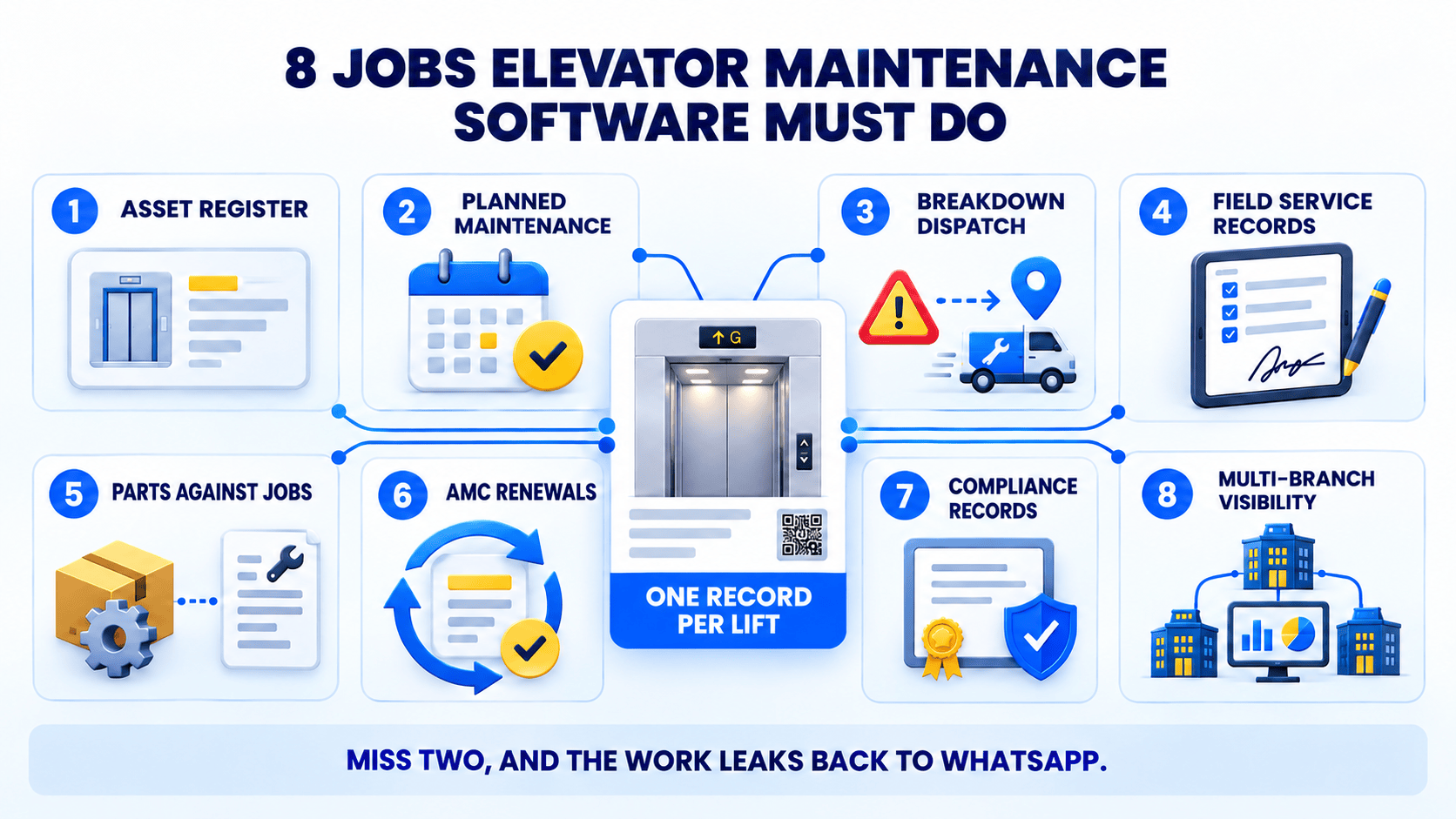
What changes in 2027 ?
From 2027, certification of newer lifts, meaning those built to SS 550:2009 or SS 626:2017 and later, moves to a firm-based licensing regime. Certification will be carried out by BCA-licensed firms accredited under the Singapore Accreditation Council's Lifts and Escalator Certification Firm scheme, which launched in April 2025.
This is a structural change rather than a procedural one. Contractors who currently rely on relationships with individual SPEs should be thinking now about which accredited firm they will work with, because the transition will compress demand.
What a Singapore contractor should be recording?
- Every monthly maintenance visit, dated, attributed, against Fourth Schedule outcomes.
- Annual examination reports and SPE certification.
- Every defect raised, with rectification dated and evidenced.
- PTO expiry per lift, with an alert at least four months out so the three-month renewal window is not a scramble.
- Reportable incidents, with the time of awareness recorded, because that is when the six-hour clock started.
- Contractor registration and workhead currency, plus technician competency.
Across a few hundred units this stops being filing and becomes an operating requirement. Our Singapore and Southeast Asia operations guide covers the wider regional picture, and the Southeast Asia growth guide covers Philippines, Indonesia and Malaysia.
Frequently asked questions
1. What law governs lift maintenance in Singapore?
Since 1 October 2025, the Building Control Act 1989 and the Building Control (Fixed Installations) Regulations 2025. These replaced the Building Maintenance and Strata Management Act framework and its 2016 lift regulations, which were repealed.
2. How often must a lift be serviced in Singapore?
Monthly, or at the manufacturer's recommended interval if that is more frequent, under reg 39. Home lifts, vertical platform lifts and stairlifts are every three months or manufacturer's recommendation, whichever is more frequent.
3. How long is a Permit to Operate valid?
Twelve months. Renewal examination work must begin within three months before expiry.
4. Who can maintain lifts in Singapore?
A BCA-registered fixed installation contractor holding workhead RW02B for lift maintenance, inspection and testing. Registration sits under Part 5B of the Building Control Act.
5. Who witnesses the annual lift examination?
An independent Specialist Professional Engineer, who must certify they are not connected to the owner or the service contractor. A registered Fixed Installation Inspector may assist an SPE at annual inspections.
6. What is SS 550?
SS 550:2020 with Amendment No. 1 (2022), the Code of Practice for the installation, operation and maintenance of electric passenger and goods lifts, accepted by BCA as an acceptable solution for compliance.
7. Can maintenance frequency be reduced?
Yes, in principle. Reg 40 allows the Commissioner of Building Control to approve reduced frequency where an approved remote monitoring and diagnostics solution is in place.
8. When must a lift incident be reported to BCA?
A reportable safety incident must be reported within six hours of becoming aware or reasonably suspecting. A reportable safety risk must be reported within 72 hours. The categories are set out in the Second Schedule to the Reportable Matters Regulations.
Singapore's regime is demanding and it rewards contractors who take documentation seriously, because an independent SPE reads your records in front of the client who decides whether to renew you.
The immediate job is unglamorous: update every template, schedule and client-facing document that still cites the BMSM regulations. Then get monthly service records, annual examination outcomes, defect closure and PTO expiry onto one record per lift, captured at the point of work.
The 2027 firm-based regime is close enough to plan for now. So is reg 40, if you have the monitoring capability to use it.
👉 Make every lift permit-ready. Book a demo →
Related reading
- Elevator Service Management Software in Singapore & Southeast Asia
- Elevator Business Growth in Southeast Asia: Philippines, Indonesia & Malaysia
- The Complete Lift Maintenance Checklist for 2026
- Elevator Complaint Tracking: Turning Breakdowns into Customer Loyalty
About the author · Nutan Mandal is part of the ElevatorPlus team, which builds the Elevator Business Operating System used by 200+ elevator companies across 20+ countries. Compliance reviewed by Mr. Sumeet Katariya.
Sources: Building Control (Fixed Installations) Regulations 2025 (S 614/2025), Singapore Statutes Online · BCA, Fixed Installations legislation · BCA, Application for Permit to Operate · BCA, Registrable activities and workheads · BCA, Duties of Specialist Professional Engineers (PDF) · BCA, Firm-based certification regime · BCA, Reportable matters · SS 550:2020, Singapore Standards eShop
👉 Follow ElevatorPlus on,
Instagram LinkedIn Facebook YouTube Qoura Substack Twitter